Study guide · Janusz Korczak · 1922
King Matt the First — themes, quotes & discussion questions
The big ideas in Korczak's novel about a boy king, the lines from the book that carry them, and questions to talk about at home or in class: one set for ages 9–12, another for teenagers and adults. Contains spoilers.
Themes
What the book is really about
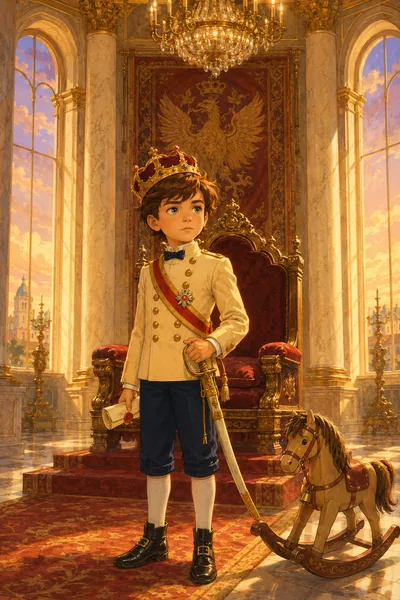
King Matt the First is an adventure story, but Korczak uses the adventure to ask hard questions: who holds power, who gets heard, and what it costs to change things. In the Polish original, and in our English audiobook, the hero is called Maciuś. Many English readers know him as Matt.
- Childhood and power
- Children's rights and a voice
- Reform and responsibility
- The real face of war
- Friendship, loyalty and betrayal
- Truth, lies and newspapers
- Korczak's own ideas about children
- Reading a book from 1922
Childhood and power
From the first chapter, Korczak shows a king who cannot reach the door-handles. Maciuś wears the crown, but the ministers meet behind locked doors, decide on war without him and parade a porcelain doll in his place. Court etiquette controls his breakfast, his walks and even whether a stove may heat the throne room. The book keeps asking what a title is worth without knowledge, allies or the right to be told the truth, and how quickly real power can turn a child (or his friend Felek) into someone else.
Children's rights and a voice
Maciuś's most radical act is simply to take children seriously. He stops his secretary throwing their letters away, receives children in the throne room, and, following the journalist's idea, gives them a newspaper and a parliament of their own, with door-handles set low enough for them to open. Korczak lets the experiment be both moving and ridiculous. The young members ask for watches, pockets and "no girls", but they also complain, quite fairly, about teachers who laugh at them and punish them unfairly.
Reform and responsibility
Every good idea in the book collides with reality. Chocolate for five million pupils takes weeks to make and deliver. The summer houses leak. Money runs out. The Day of Role Reversal wrecks trains, factories and hospitals. The Sad King is the book's voice of experience: his grandfather gave the people freedom and was murdered for it, and he warns Maciuś that reform is paid for "with tears, and with blood". Korczak never says reform is wrong, only that it needs patience, knowledge and honest helpers.
The real face of war
Maciuś goes to war dreaming of a white horse and flowers, and finds trenches, fleas, hard biscuit and orders that must be obeyed without argument. He learns why the ministers talked about boots and oats. He shows mercy to a defeated king and refuses to chase the beaten enemy. The last war shows its other side: surrender, humiliation and a crowd in the street jeering at a boy in chains.
Friendship, loyalty and betrayal
The book is full of loyalty tested. Felek is a true comrade in the trenches and a disaster as a minister. Klu-Klu crosses the sea for Maciuś and stays with him to the end. The Sad King joins the war against Maciuś, hoping to protect him from inside the alliance, and asks to be trusted "even when you think I have betrayed you". The city that cheered the boy king raises white flags at the moment his trick is working. Maciuś's own choice, again and again, is to forgive.
Truth, lies and newspapers
A porcelain doll saluting in a car; "diplomacy", which the narrator says "means lying about everything"; a newspaper that praises the king while the country falls apart; forged letters, a forged dismissal and a forged proclamation. Much of Maciuś's downfall comes from lies told in print. For older readers the novel is a surprisingly modern study of propaganda and disinformation.
Korczak's own ideas about children
Janusz Korczak, born Henryk Goldszmit in Warsaw in 1878, was a paediatrician and educator. In 1912, with Stefania Wilczyńska, he opened Dom Sierot, the Orphans' Home on Krochmalna Street in Warsaw, where the children had their own parliament, peer court and newspaper. King Matt reads like that experiment turned into a story: it asks what happens when children really do get a say, and answers honestly that they need time, practice and adults who listen rather than give up. His ideas about children's rights are often linked with the UN Convention on the Rights of the Child (1989), whose first draft Poland proposed. In August 1942 Korczak refused offers of rescue and went with the children of Dom Sierot from the Warsaw Ghetto to Treblinka, where they were murdered. More on his life: Janusz Korczak.
Reading a book from 1922
Some chapters, especially the journey to King Bum-Drum and the visit of the African kings, use the colonial "cannibal" stereotypes common in European adventure stories of the 1920s, along with remarks about skin colour that readers today will rightly find offensive. At the same time, Korczak makes Klu-Klu one of the most capable and admirable characters in the book, has Maciuś defend his African friends against the "white kings", and shows local workers quietly saving his mission. We recommend reading these chapters with children rather than skipping them, and talking about what has changed. Question 13 below is a place to start.
Quotes
Key quotes and where they come from
All quotations are from our English translation of the novel.
"I'll pay them back for it, when I am king," thought Maciuś.Chapter 1 — at his dying father's bedside, after hearing the ministers laugh at him
The first thing power means to him is revenge. The book traces how that idea changes into forgiveness.
"The multiplication table is the same for kings as for everyone else. So what is the good of being a king?"Chapter 2 — Maciuś, after being banned from the public garden
The child-king discovers that a crown does not free him from the rules every child lives by.
"You don't know a true hero by his victories, but by how he stands in defeat."Chapter 9 — the general, praising the soldiers who kept their rifles during the retreat
A line that looks forward to the ending, where Maciuś loses everything but his dignity.
"I only thought about how I would ride out of the capital on a white horse, with the people scattering flowers under its hooves. And I never thought about how many men would be killed."Chapter 9 — Maciuś during the retreat
The dream of glorious war meets reality.
"Defeated king," said Maciuś, "I know what it is to be a prisoner. I grant you your freedom."Chapter 12 — freeing the captured enemy king
Mercy learned from his own experience, and the first sign of Maciuś as a ruler.
"Surely not to wear a crown, but to give happiness to the people of his country."Chapter 18 — the Sad King, when Maciuś asks what a king is for
The book's clearest definition of leadership.
"You know, Maciuś, we always did it wrong, giving reforms to grown-ups. You try it with the children. Perhaps you will succeed."Chapter 18 — the Sad King, at night
The seed of the children's parliament.
"If a letter is written to me, I am the only one who can know whether that letter is important or not."Chapter 24 — Maciuś, discovering the children's letters in the rubbish
A simple statement of a child's right to be heard.
"But you have forgotten, my lords, that the nation is not only grown-ups, but children too."Chapter 26 — Maciuś proposing a children's parliament to his ministers
The political heart of the novel.
"But remember: reforms are paid for with hard work, with tears, and with blood."Chapter 36 — the Sad King's warning during the visit of the kings
The warning Maciuś hears but does not yet understand.
"You mustn't think about what has been, but about what should be, what will be, what must be."Chapter 46 — Maciuś to Felek, after the spy has escaped
The boy has become a leader who looks forward, not back.
"I am, and I shall remain, King Maciuś the First."Chapter 52 — his answer to the city's renunciation, written at his trial
Defeated, but unbroken.
Discussion questions
Questions to talk about
Pick three or four. There are no single right answers; ask for evidence from the story. For a ready-made 45-minute lesson on chapter one with a worksheet, see our King Matt the First lesson plan.
For ages 9–12
- Maciuś cannot open the palace doors because the handles are too high. What things in your world are "too high" for children? What would you change first?
- Maciuś says that although he is king, he has to obey everybody. Who really has power in the palace at the start of the story? How do you know?
- Felek is a brave friend in the war but behaves badly when he becomes a minister. Why do you think he changes? Was Maciuś right to forgive him?
- Why does it matter so much to Maciuś to read the children's letters himself? What would you write in a letter to a king?
- The children's parliament asks for watches, more pockets and "no girls". Which wishes are fair, which are silly, and how would you decide?
- On the Day of Role Reversal the grown-ups go to school and the children do their jobs. What went wrong, and what did each side learn?
- Klu-Klu is braver and quicker than almost anyone else in the book. Which thing she does impressed you most, and why?
For teenagers and adults
- The Sad King says, "we ourselves make bad laws, and then we have to obey them." Find examples in the book of rules that have outlived their reason (the throne room with no stove, the royal teeth kept in gold). Where do you see such rules today?
- Maciuś's reforms fail partly because of his enemies and partly because of his own haste. Where does the balance lie? Was the children's parliament a mistake, or simply ahead of its time?
- The journalist's paper praises the king while the country falls apart, and a forged proclamation starts the final war. What does the novel say about the press and propaganda? Does anything feel familiar?
- The Sad King joins the war against Maciuś, hoping to be "of some use" to him. Is that betrayal, cowardice or realism?
- Korczak ran an orphanage with a children's parliament and court. Is King Matt optimistic or pessimistic about children governing themselves? Support your answer with scenes.
- The book describes Bum-Drum's kingdom with 1920s colonial stereotypes, yet makes Klu-Klu one of its most capable characters. How should we read and teach passages like these today?
- The city raises white flags just as the battle turns. Who is most to blame for Maciuś's fall: the enemy kings, the spy, Felek, the frightened citizens or Maciuś himself?
- The novel ends with a single sentence: the narrator will write about the island "when I find out myself". Why might Korczak have ended the book this way?
Frequently asked questions
What is King Matt the First about?
It is the story of a boy who is crowned king when his father dies and then tries to rule for real. He runs away to fight in a war, visits foreign kings, makes friends with the African king Bum-Drum, and introduces bold reforms for children, including a children's parliament and a children's newspaper. His reforms go wrong, jealous neighbouring kings invade, and he loses his throne. Janusz Korczak wrote it in 1922. Read the full summary.
What is the main message of King Matt the First?
Children deserve to be listened to and taken seriously, but good intentions are not enough to change the world. The book shows that power brings responsibility, that reforms need patience, knowledge and honest helpers, and that adults and children have to learn to govern together rather than simply swapping places.
How does King Matt the First end?
Maciuś is defeated, captured with sleeping gas, tried and sentenced to be shot. At the last moment the three victorious kings pardon him, as they had secretly agreed, and send him into exile on a desert island. The final chapter is a single sentence promising to tell what happened on the island later. The story continues in the sequel, King Matt on the Desert Island.
Why is the king called Maciuś in the audiobook and not Matt?
Maciuś (pronounced MAH-choosh) is the hero's name in Korczak's Polish original, a fond, childish form of Maciej. English readers often know him as Matt. Our English audiobook keeps the original name.
What age is King Matt the First suitable for?
We suggest ages 9 and up. Younger listeners enjoy it as an adventure. The book also includes war, a death sentence and 1920s stereotypes of Africa, so it works best when an adult is around to talk it through. Teenagers and adults will find a serious novel about power and politics.