Study guide · Janusz Korczak · 1922
King Matt the First — summary, chapter by chapter
What happens in Janusz Korczak's novel about a boy who becomes king: a short spoiler-free overview first, then the whole story in ten parts, the ending, and where the story goes next. Written for parents, teachers and students.
No spoilers
The story in a nutshell
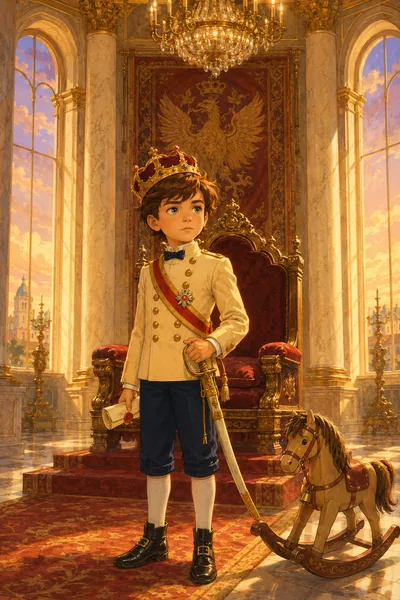
When the old king dies, his only son is crowned — a small boy who cannot yet write, surrounded by ministers who would rather rule without him. King Matt the First follows this child-king as he tries to become a real ruler: he runs away to fight in a war, travels to distant kingdoms, makes friends with a very unusual king, and decides that the children of his country deserve a say in how it is run. His reforms are bold, generous and often funny. They are also expensive, hard to carry out, and watched with growing jealousy by the kings next door.
Korczak wrote the novel in 1922 as a doctor and head of a Warsaw orphanage, and it reads like two books at once: an adventure story for nine-year-olds, and a serious, often bitter look at power, war and the way adults treat children. There are no fairy-tale shortcuts. Every good idea has a price, and the boy pays it.
A note on the name. In the Polish original the king is called Maciuś (say MAH-choosh), a fond, childish form of the name Maciej; English readers usually know him as Matt. Our English audiobook keeps his original name, so the quotations on these pages say Maciuś.
Contents
The book in ten parts
The novel has 53 short chapters. Our English audiobook is also published as a serial in ten parts, and this summary follows those parts:
- The Young King (chapters 1–4)
- Off to the War (5–9)
- The King Returns (10–15)
- Kings and Reforms (16–20)
- The Journey to Bum-Drum (21–25)
- The Children's Parliament (26–30)
- Intrigues at Court (31–35)
- Klu-Klu in the Capital (36–40)
- The World Turned Upside Down (41–46)
- War and the Island (47–53)
Spoiler warning: from here on, the summary tells the whole plot, including the ending.
Part 1: The Young King
Chapters 1–4The king is dying. Behind a locked door the ministers argue: by law his son must inherit the throne, but the boy "cannot even write yet". A foreign ambassador walks in and demands that Maciuś be crowned — or there will be war — and the frightened Prime Minister scribbles on a scrap of paper in blue pencil: "Very well, let there be war." Woken by the noise, Maciuś wanders the corridor. He cannot open the doors because the door-handles are too high for him, and through them he hears the ministers drinking the king's wine and laughing at him. At his father's bedside the kind old doctor takes him on his knee.
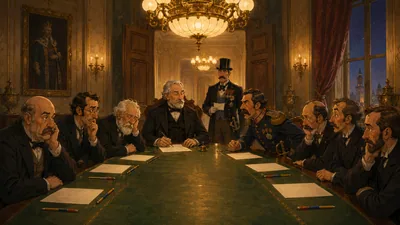
The council of ministers 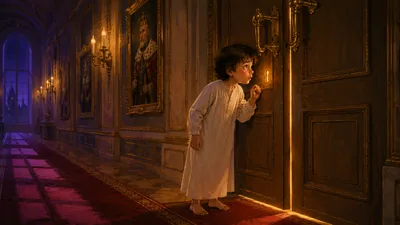
Door-handles too high 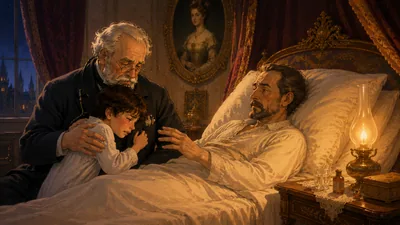
At his father's bed
After the funeral Maciuś is king in name only. Court etiquette rules every minute: a breakfast timed to the second, a throne room with no stove, cod-liver oil instead of wine. On a rare walk in a public garden he meets Irenka, a fire-brigade captain's daughter who dreams of a doll "that reaches right up to the ceiling" — and, stamping his foot like his father, he makes the ministers buy it. He also longs to befriend Felek, a sergeant's son he watches through the palace railings. He learns to write just to send Felek a letter, and the two set up a secret post with a whistle and a cuckoo-call. Then three countries declare war. The ministers hide it from him; Felek tells him. Maciuś faces down the council and a staged cabinet crisis, tells the departing enemy envoys he will beat them and offer "gentle terms of peace" — and, discovering that the army has been marching for a week without him, decides to run away to the front with Felek under a false name: Tomek.
Part 2: Off to the War
Chapters 5–9At night Maciuś climbs the palace fence and follows Felek through a vast army camp, in patent-leather pumps and a badly knotted tie. They are smuggled onto a troop train, where the soldiers happily drink the tutor's stolen brandy. Maciuś hears things no king is told: that kings don't go to war any more, and that the soldiers do not much love them. From a switchman's cottage he watches the Minister of War pass by in the royal train.
At the palace, meanwhile, the ministers cover up the king's disappearance. The Prefect of Police searches the palace pond in a diving suit, and the Prime Minister orders a lifelike porcelain doll of Maciuś that salutes when you pull a string. The doll is driven round the capital every day so that no one suspects a thing.
At the front Maciuś learns what modern war really is: digging trenches, stringing barbed wire, obeying orders at once — and retreating for three days through the forests on nothing but hard biscuit, because the commander pushed too far. Now he understands why the council talked about boots and oats instead of white horses. The soldiers nickname the boys Mountain-Mover (Felek) and Oak-Puller (Maciuś). Slightly wounded, Maciuś enjoys his first real bed in four months, refuses to be photographed in case he is recognised, and insists on going back to the trenches.
Part 3: The King Returns
Chapters 10–15Felek, bored with trench life, joins the air force, which needs light soldiers. Maciuś, disguised as a crying shepherd boy, crosses to the enemy lines. An enemy officer tries to recruit him as a spy and foolishly shows him where their own ammunition is kept; Maciuś reports it, the artillery blows up the powder magazine, and he wins a medal. In the spring he is captured during a pretend attack, recognised as the boy who spied on the enemy, and tried by a field court.
The enemy discovers the secret of the porcelain doll, has it smashed with a stone and drops leaflets telling Maciuś's army that it has no king. Felek reveals the truth, and a daring air raid snatches the unconscious Maciuś from his prison. Now the army knows its king is alive and among them. The attack succeeds: of the three enemy kings, one is routed and captured and another badly beaten. Maciuś sets the captured king free, decides not to chase the beaten enemy, and makes peace.
Back home he rides through the capital on a white horse, tumbles off when it shies, and sleeps until noon the next day. Then comes his fight with the ministers. When they drone on about money and the Minister of Justice quotes endless volumes of law, Maciuś claps his hands and has them all arrested. Alone with a pile of papers he cannot understand, he realises he cannot rule without them; Felek simply suggests letting them out. The deal: Maciuś becomes "King Maciuś the Reformer" (not "the Tyrant"), must take back the paper naming Felek his official favourite, and orders chocolate for all five million schoolchildren — which, he learns, takes weeks to make and deliver.
Part 4: Kings and Reforms
Chapters 16–20Maciuś now has lessons with his old lieutenant, promoted to captain, whose children Staś and Helcia move into the palace. The gloomy palace fills with games. To pay the war debts the ministers draft a vast loan request to the foreign kings, and Maciuś adds a line of his own at the bottom: "So don't be swine, and lend me the money."
He is invited abroad. The old grey-haired king gives him a hero's welcome; the second king, whom Maciuś had freed from captivity, shows him the world's biggest zoo. The third, the Sad King, lives plainly and plays the violin mournfully. He did not want the war. He tells Maciuś that a king's job is "to give happiness to the people", that reforms are the hardest thing of all, and that grown-ups have always been given reforms in vain: "You try it with the children." He shows Maciuś a parliament, where someone shouts "Down with the king!"
At the seaside, travelling incognito, Maciuś learns from the doctor how many children live in damp, dark homes and go hungry. He plans three reforms: summer houses in the forests and mountains, swings and merry-go-rounds in every school, and a zoo. But the ministers have already shared out the loan. The Sad King's envoy offers money only if Maciuś grants a constitution so that "the whole nation" rules — and the ministers agree surprisingly quickly. Then an envoy arrives from the far-off King Bum-Drum with an invitation, and Maciuś accepts.
Part 5: The Journey to Bum-Drum
Chapters 21–25The ministers are horrified, but Maciuś sets off with the doctor, the captain, Felek and an old professor who speaks fifty languages. After a ship, a railway and a gruelling desert crossing by camel caravan, they reach Bum-Drum's kingdom. Korczak's 1922 portrait of this land relies on the "cannibal" clichés of European adventure stories of his time, and modern readers will want to discuss it (see our themes page). An offended priest poisons Maciuś's wine, and he sees the world turn red, then blue, then green, until Bum-Drum forces a bitter antidote down his throat. The two kings become blood brothers. Maciuś begs Bum-Drum to give up eating people; Bum-Drum answers that a king who once tried was poisoned for it, but promises to think it over. On the last night Bum-Drum's small daughter, Klu-Klu, follows Maciuś into the moonlit forest, crying because she wants to go with him.
Maciuś returns with a caravan of gold. The constitution is proclaimed, and he announces gifts for every child: balls, skates, sweets, dolls and penknives. Then he finds out that the children's letters to him are being thrown away unread. He insists on reading them himself, is buried under thousands, and works out a fairer system with the old secretary. Clerks now choose a hundred letters a day and check the requests, and in the afternoons Maciuś receives children in the throne room and gives them what they really need: shoes, a warm coat, school books, a violin.
Part 6: The Children's Parliament
Chapters 26–30A long-haired journalist forces his way into an audience and gives Maciuś his biggest idea: children are part of the nation too, so there should be two parliaments, one for adults and one for children, and a daily newspaper for children. Maciuś puts it to the council: "the nation is not only grown-ups, but children too." Felek is to be the children's minister. Builders get to work on summer houses, the zoo and two parliament buildings. In the children's building the door-handles are set lower.
But the foreign kings grow jealous of Maciuś's gold and his friendship with Bum-Drum. Maciuś sits up at night writing letters to split them apart, and wears himself out. The kings agree to visit only if Bum-Drum is not invited, so Maciuś decides to fly to Africa to see for himself whether Bum-Drum has stopped eating people. His pilot is a brave veteran with no legs and one eye. At a desert garrison, on secret orders from the white kings, a soldier disguised as a porter removes a vital little wheel from the engine; local African workers dig it up and quietly put it back. Over the desert the plane runs an hour late, collects a dozen arrows from bandits at an oasis, and at last lands in a clearing packed with people — where Klu-Klu throws her arms round Maciuś's neck.
Part 7: Intrigues at Court
Chapters 31–35The priests are about to burn Bum-Drum for trying to change the old customs. The plane's arrival fulfils an old prophecy, down to the poisoned arrows in its wing: the pilot dies after pricking himself on one of them, the oldest priest burns himself on the pyre, and Maciuś is proclaimed king of all the African kings, who promise to stop eating people. He brings Bum-Drum home.
A happy snowball fight is interrupted by a spy chief with bad news. The old king's son has secretly built a fortress and an ammunition factory, and has bribed someone at Maciuś's court to swap the invitations to the kings for a forged declaration of war. Maciuś reluctantly allows the spies to burn the factory, and understands at last why the Sad King plays so sadly. The traitor, an assistant secretary, is caught in the act at the sealing ceremony. He is sentenced to hang, and Maciuś commutes the sentence to life in prison. The journalist's odd questions make Maciuś briefly suspicious. Then the kings arrive — white, yellow and black — and a week of feasts, hunts and near-disasters begins, with Bum-Drum trying to keep order among the African guests.
Part 8: Klu-Klu in the Capital
Chapters 36–40At the opening of the zoo a crate of rare monkeys is unpacked, and out jumps Klu-Klu, who has travelled for six weeks hidden among them. Maciuś takes her side, and she stays to study. She learns the language astonishingly fast and greets the first children's parliament in the world. The Sad King warns Maciuś that "reforms are paid for with hard work, with tears, and with blood". The old king, meanwhile, gives Maciuś a sea port — a "diplomatic victory".
Exhausted and thin, Maciuś is put to bed by the doctor and sent to the countryside for the summer. The Prime Minister stands in for him with the adults and Felek with the children. Klu-Klu chases squirrels through the treetops, catches vipers and teaches the village children to read. Felek arrives calling himself "Baron Feliks von Rauch", and Maciuś signs everything he asks for just to be left in peace.
Back in the capital, jobless workers march with red flags. The children's parliament reopens with complaints about leaking roofs at the summer houses, and a riot of wishes: watches, more pockets, no kissing by aunts, no girls. When Klu-Klu stands up for the girls, the chamber explodes. Felek hurls an inkwell, and Klu-Klu leaps down from the royal box and flattens Antek, the loudest troublemaker.
Part 9: The World Turned Upside Down
Chapters 41–46Deeply hurt, Maciuś nearly gives up on the children's parliament. The idea of children's rights spreads abroad: in Queen Kampanella's country children march under a green flag. At home, teenagers riot because they have no parliament of their own, teachers threaten to quit, and Maciuś hastily announces that pupils will be paid for studying — until Felek and the journalist remind him that laws now belong to parliament. Then Felek wins a vote for something far wilder: the grown-ups go to school, and the children take over their jobs.
The Day of Role Reversal is funny at first, with parents getting homework and children keeping shop. Then a thousand African children arrive instead of a hundred, thanks to one extra zero in a telegram. Twelve wolves escape from the zoo because the new child keepers don't know how the cages work, and Maciuś saves Klu-Klu from the last wolf in the city's sewers.
The Sad King arrives in secret with a bundle of foreign newspapers: "KING MACIUŚ HAS GONE MAD". Walking the city in disguise, Maciuś sees the damage for himself: broken cannon, a burst factory boiler, looted shops, a train crash with a hundred dead, patients left untended. He confronts the journalist, who turns out to be a spy and escapes. Felek confesses in tears that he stole parcels meant for poor children, took bribes, and let the journalist make him forge documents. The Sad King leaves behind a secret letter to be burned, and Maciuś puts on a crown that feels heavier than ever.
Part 10: War and the Island
Chapters 47–53Order is restored in a single day. But the old king has handed his crown to his son, and the son invades. Maciuś's offer of half his gold comes back with two words scrawled on it: "There are no fools!" The insult unites the capital behind its king: "Win or die." The first battle is held, but the spy-journalist uses a forged proclamation, in which Maciuś supposedly calls on the children of the whole world to overthrow their kings, to turn the other two kings against him — even the Sad King, who joins in the hope of protecting Maciuś.
Short of gunpowder, Maciuś's army tries a trick devised by Klu-Klu: Felek spreads a rumour of African troops and wild beasts, and in the final battle lions and tigers from the zoo are released and the African children charge with drums and arrows. The enemy panics — and at that very moment the frightened city raises white flags. The army surrenders. With Felek, Antek, Klu-Klu and a few dozen soldiers, Maciuś holds out in the empty lion house until the kings put him to sleep with gas.
At his trial he refuses to sign the city's renunciation of his crown and writes instead: "I am, and I shall remain, King Maciuś the First." He is sentenced to be shot and led through the streets in golden chains. At the very last moment the three kings, as they had secretly agreed, read out a pardon: exile to a desert island.
How the book ends
The ending is deliberately unfinished. The victors have agreed that Maciuś will spend his first year on the island alone under guard, and may then be joined by ten people who wish to come. Chapter 53 is a single sentence in which the narrator promises to tell what happened on the island "when I find out myself". Korczak ends the book with his hero defeated but unbroken: he never begged for mercy, and he never stopped calling himself king. He has lost his kingdom largely through other people's jealousy, betrayal and cowardice, and partly through his own haste and trust.
What happens next
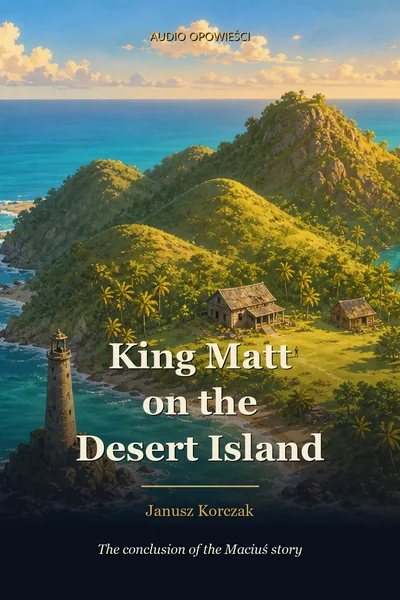
Korczak kept that promise the following year with a sequel, King Matt on the Desert Island (1923), which follows the deposed boy into exile and brings his story to a close.
Volume 2 · the sequel
King Matt on the Desert Island
The boy who was king is sent into exile, and his story reaches its end. English audiobook, complete or in 7 parts.