 Mystery
The Devil from the Seventh Grade
Adam Cisowski untangles a 124-year-old riddle of Napoleonic treasure — with humour that has not aged a day.
Author
The great humorist of interwar Poland — creator of Koziołek Matołek and of novels that, ninety years on, children still read for pleasure rather than out of duty. His The Devil from the Seventh Grade is an illustrated audiobook at Audio Opowieści.
Who he was
He was born in Stryj, studied Polish and French literature in Lwów and Paris, and first made his name as a columnist and poet. But he is remembered above all as an author for young readers. Together with the illustrator Marian Walentynowicz he created Koziołek Matołek (1933) — Poland's first picture story, a comic before the word existed, and a character every Polish child still recognises. Then came the novels: O dwóch takich, co ukradli księżyc (the two boys who stole the moon), Panna z mokrą głową (The Madcap Miss), Awantura o Basię and Szatan z siódmej klasy — The Devil from the Seventh Grade (1937).
What his books share is a rare mixture: humour that never mocks its heroes, an unshaken faith in kindness, and clever children who are wiser than the grown-ups suspect. Makuszyński was a member of the Polish Academy of Literature; after the war he lived in Zakopane, in the Tatra Mountains, where he died in 1953. The town keeps a museum in his name.
"Adam Cisowski, a seventh-grader, was a devil — but the kind of devil even the teachers forgave."paraphrased from The Devil from the Seventh Grade
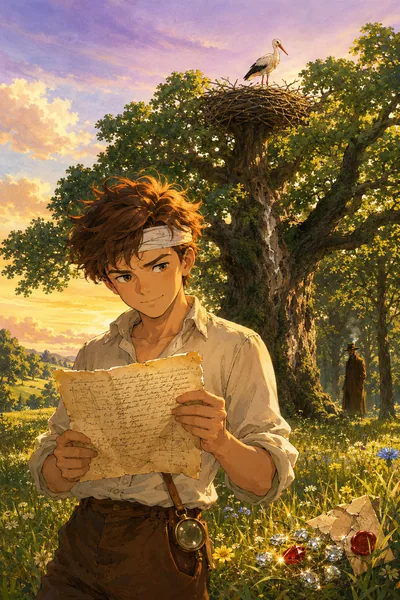
Because it is a detective story in which the solution demands thinking: letters, dates, verses, a calendar. Adam Cisowski, the sharpest boy in his class, untangles a 124-year-old mystery — a treasure hidden by a French officer after Napoleon's 1812 campaign — with humour that has not aged a day, and with Professor Gąsowski, who knows everything about Napoleon and nothing about life. In Poland it is supplementary school reading, usually around ages 11–12, but it reads like an adventure, not like homework.
For a child growing up in English, or learning it, the English edition offers a classic plot in a new language: voice and text side by side, illustrations of fifteen characters, three scenes from the first chapter. For families with Polish roots, it is a bridge — the same book grandparents read at school, in the language the child speaks best.
1933, with Marian Walentynowicz — Poland's first picture story. "Every child knows him" is not an exaggeration.
The Devil from the Seventh Grade is on Poland's supplementary reading list for ages 10–14; two film adaptations (1960 and 2006).
Adam solves the riddle with his head, not his fists — a good model for a twelve-year-old and a good excuse to talk about history.
Makuszyński's books at Audio Opowieści
Audio in English, with a character gallery, scene illustrations and the full text in the app. The Madcap Miss — coming later.
MysteryAdam Cisowski untangles a 124-year-old riddle of Napoleonic treasure — with humour that has not aged a day.
Questions
Kornel Makuszyński (1884–1953) was a Polish writer, poet and columnist, one of the most popular authors for children and young people in interwar Poland. With the illustrator Marian Walentynowicz he created Koziołek Matołek (1933), Poland's first picture story; his novels include The Devil from the Seventh Grade, The Madcap Miss and the story of two boys who stole the moon. He was a member of the Polish Academy of Literature.
In Poland, yes — it is on the supplementary reading list for primary school (ages 10–14), most often taught around ages 11–12. More for teachers and parents: for schools, for parents.
At Audio Opowieści: The Devil from the Seventh Grade — an illustrated audiobook in English, with a character gallery and the full text in the app. The Madcap Miss (Panna z mokrą głową) is coming later.
From about 12 — for a teenager who likes a puzzle. A little history (Napoleon and 1812), a little first romance, a lot of laughter.
See also: Janusz Korczak — King Matt the First · Polish children's classics in English · why we make Audio Opowieści · guide for parents