Study guide · Kornel Makuszyński · 1937
The Devil from the Seventh Grade — summary
A schoolboy who can read a teacher's mind, a manor near Wilno whose doors keep being stolen, and a riddle left behind by one of Napoleon's officers in 1813. Here is the whole story: first without spoilers, then chapter by chapter, and finally the ending.

Spoiler-free overview
The Devil from the Seventh Grade (Szatan z siódmej klasy) is Kornel Makuszyński's best-loved novel, first published in 1937 and set in the same year. Its hero is Adam Cisowski — Adaś to everyone — a seventeen-year-old pupil at a Warsaw gymnasium who notices everything. He does not merely look, the narrator tells us; he sees. When he exposes the secret system his absent-minded history teacher uses to decide which boys to examine, the old man calls him a devil, and the nickname sticks.
That teacher, Professor Gąsowski, soon comes back to ask for help. At his family's crumbling manor of Bejgoła, near Wilno (today's Vilnius), a stranger has been scraping the paint off doors, someone keeps offering far too much money for the estate, and now whole doors are vanishing in the night. Adaś gives up his seaside holiday and travels north with the Professor and his niece Wanda — a girl whose violet eyes finish off his composure in a single glance.
What follows is a summer mystery built from clues rather than gunfire: a priest's old diary, a letter from 1813 written in faded French, a line of Dante, and a secret message hidden in plain sight. It is funny on almost every page — Makuszyński loves his eccentrics — yet it has real danger in it, and a warm heart. The riddle is fair: the reader gets every clue Adaś gets.
Spoiler warning. From here on, the summary follows the plot to the last page, including who is behind the thefts and where the treasure is.
Chapters 1–2: the devil at school
Chapter 1The Devil Jumps Out of the Box
Professor Gąsowski adores Napoleon, is famously forgetful and is proud that his seventh form always knows its history. One June day the boy he calls on, Kaczanowski, knows nothing — "I wasn't supposed to be tested today" — and neither does the next. The old man is hurt to the heart, until Adaś stands up and confesses. Months earlier he had worked out the Professor's hidden method: three boys at a time, taken from the roll-book in a fixed order. Adaś had told the whole class, so every boy learned only his own lesson. That morning the pages of the roll-book had stuck together.
"You devil! You little Satan!" cries the Professor, and challenges him: on Saturday Adaś must guess in advance which three boys will be called. Adaś guesses correctly — he reasons that the Professor will choose the simplest possible answer, and he watches the pen as the names are written. Then, asked why three friends never replied to the Professor's letters, he points out that the letters are still in the Professor's pocket.
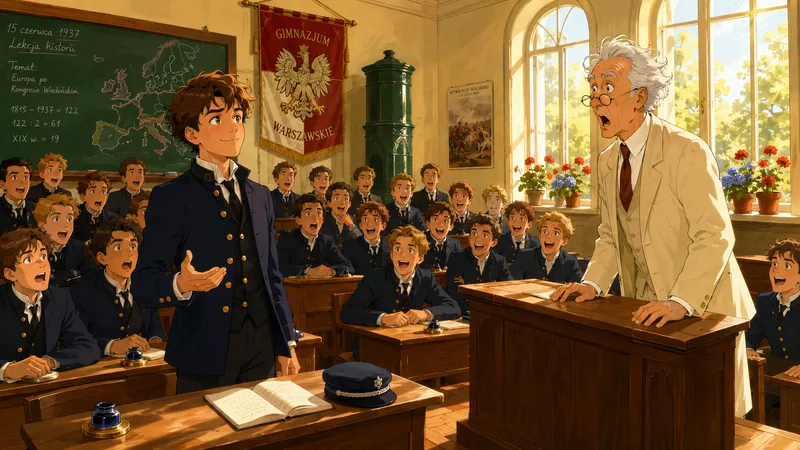
Two Rows, Each Worse Than the Other
We meet Adaś's family — his father is a doctor, and four noisy younger siblings fill the flat — and learn how he once caught little Janek stealing his ice cream with a trick borrowed from an Arabic tale. At school two boys, Jasiński and Żelski, almost come to blows over a missing fountain pen. Adaś vouches for Żelski's innocence; he has noticed that his own benchmate, Staszek Burski, whose handwriting is usually a scrawl, has suddenly started writing neatly in green-tinted ink. He confronts Burski privately, retrieves the pen from the stove and returns it without shaming anyone. Then the sixth form begs him to save a poor boy whose co-operative shop accounts are a hundred złoty short. Working through the night with a magnifying glass, Adaś finds the culprit: a black thread stuck to the ledger just before a figure, turning 26 złoty 30 groszy into 126.
Chapters 3–5: Bejgoła and the stolen doors
Chapter 3Lovely Are the Violet Eyes — But Who Stole the Door?
The Professor calls on Adaś at home and asks him to come to the country. At the Professor's flat Adaś meets his niece Wanda and falls in love on the spot. Wanda explains what is happening at Bejgoła: six months earlier a Frenchman asked to see the house, looked only at the doors and secretly scraped one; then an agent offered an absurd price for the heavily indebted estate, and her father threw him out; finally burglars carried off two door leaves, which were found in the park stripped of their white paint. Adaś, characteristically, guesses the doors before Wanda says the word. A letter the Professor has absent-mindedly left in the fourth volume of The Count of Monte Cristo reports another attempt, this time by two men.
Chapter 4Two Beards and a Phantom Man
At Bejgoła Adaś meets Wanda's father, Iwo Gąsowski, a small man with an enormous bass voice and a dyed black beard, who has spent years trying to prove Fermat's theorem while the estate sinks into debt, and her patient, overworked mother. The manor is poor, sleepy and full of creaking doors and badly painted ancestral portraits. That evening Adaś and Wanda spot a man creeping from the woods, from the direction of the empty Winnicki house at Żywotówka. Adaś stalks him like a hero of Karl May's novels — and is knocked senseless under a lone tree.
Chapter 5A Frenchman Walks on a Cracked Head
Wanda, it turns out, carried him home herself. Bandaged and bedridden, Adaś reasons that the secret must be old and must concern a Frenchman. Iwo is sure thieves are after his mathematics (he has put it all in cipher and burned the originals). The Professor explains that the family portraits were painted all at once in 1786–87 by a card-sharp artist — which is why one chamberlain has only one eye. Then Wanda leads an expedition to the attic, full of old papers.
Chapter 6: the story of 1813
A Small Light Glimmers in the Dark
After nights of reading, Adaś wakes the Professor: "I have a Frenchman." In the diary of Father Jan Koszyczek, a relative living at Bejgoła, he has found the story of two Napoleonic soldiers who stumbled out of the snow early in 1813, after the retreat from Moscow. One of them, an engineering officer named Kamil de Berier, had terribly frostbitten legs; the family lodged the pair in the little gardener's cottage in the park. The officer guarded a heavy pack-bag, crawled out of the house on moonlit nights, drew and calculated something, and gave his companion a sealed letter sewn into his coat for his younger brother, Armand. Before dying he begged the master of the house to welcome that brother and, if he never came, gasped: "Those doors! Look there —". He died crying "Vive l'Empereur!"
Chapters 7–8: the painter and the Dante riddle
Chapter 7The Painter Says He Found What He Stole
The cottage turns out to have no doors at all — they vanished long ago. Then a wandering "painter" arrives asking for a room. Adaś notices his heavy, clumsy hands and, when Iwo begins to chatter about stolen doors at supper, shouts "Fire!" to stop him. The Professor tests the guest by asking him to paint in the missing eye on the ancestral portrait; the man pleads that he only paints landscapes. While Adaś and the Professor are busy luring Iwo out of his study, the impostor ransacks Adaś's room and escapes with Father Koszyczek's diary.
Chapter 8The Dead Write Letters
A court bailiff arrives with bad news about the estate's debts, and the Professor quietly takes the matter into his own hands. Adaś stages a public departure by train and instead goes scouting on foot. At the neighbouring manor of Wiliszki, where the tomboy Irenka Niemczewska commands a band of children, he learns that strangers from Żywotówka have asked for an old French letter to be translated. Adaś offers to do it. It is the colonel's letter of 1813, signed Camille de Berier: he has saved something that could restore his family's lost splendour, and he gives his brother a single coded clue — Dan. Al. Inf. C. III. 10–11. Adaś cracks it: Dante Alighieri, Inferno, Canto III, lines 10–11 — the lines about an inscription read over a gateway. The secret, then, is written on a door. When the "painter" comes to the kitchen to collect the translation, Adaś slips out after him.
Chapters 9–11: captured and rescued
Chapter 9Don't Stick Your Fingers in the Door
Adaś follows the painter to the lakeside house at Żywotówka and watches him through the window with a gaunt, skeletal partner. Asleep in a hut, he is found by their dogs and a hunchbacked caretaker, captured, searched and threatened. Forced to write a reassuring letter to the Professor, he hides a message in it: the first letters of the lines spell GUARD THE HOUSE, and he deliberately misspells the village and gives Mrs Gąsowska the wrong name. He is then tied up and carried to a cellar.
Chapter 10At the Bottom of the Cellar and of Despair
In the dark he finds another prisoner: the Frenchman, with a dislocated arm. He had found the colonel's letter in an old book bought from an antiquary, hired the men to help him, and was robbed and imprisoned when they realised a fortune was at stake. Behind his partners' backs, the skeletal man offers to free Adaś if he tells what he knows — then ties him up again. A storm floods the cellar — until someone breaks down the door. It is Staszek Burski and the scouts from the camp across the lake.
Chapter 11Though the Storm Roars All Around Us…
The overloaded boat sinks near the shore; the injured Frenchman saves the youngest scout. Among the rescuers is the boy from the co-op accounts, Szostak. The Frenchman is hidden with Father Kazuro, a kindly, penniless village priest, who happens to tell Adaś a story: in 1863 a wounded insurgent priest was hidden in the Gąsowskis' garden cottage and carried to safety through the snow on a door taken off its hinges. That door is now in the priest's village school. At dawn Adaś prises the iron plate from around its keyhole and finds words carved underneath: "In the great house, you will find two painted beards. Do not look behind you. Look ahead, and read in the beard!" He memorises them and scrapes them away.
Chapters 12–13: the ending
Chapter 12Knock, Knock at the Little Window…
At Bejgoła the Professor notices the odd mistakes in Adaś's letter, and Iwo — an expert in acrostics and magic squares — reads the hidden GUARD THE HOUSE. The words strike the Professor in another way: he tells his brother that neither of them has been guarding the family home, and Iwo, shaken to learn how his wife has suffered, burns his mathematical papers. Burski arrives with the whole story, and that night Adaś climbs in through the Professor's window and slips up to the attic with Burski.
Chapter 13Who Refuses to Eat from a Flat Plate?
At breakfast Adaś loudly announces an evening expedition to dig up the treasure. In a clearing, the Professor and Iwo unearth an iron-bound box — and the skeletal man steps out with a revolver, takes it and drives off. Adaś laughs: he and Burski had buried the box the night before, filled with horseshoes and scrap iron from the attic. The next day's paper reports two strangers beating each other with horseshoes in an inn near Wilno.
Father Kazuro visits with two hundred-złoty notes from the grateful Frenchman, and Iwo rules that both belong to the poor. When Adaś reads the door inscription aloud, every eye turns to Iwo's dyed beard; he leaves, washes it, and returns grey — and smiling. Then Adaś, staring at a flat dinner plate, remembers the fable of the fox who served the stork its dinner on a flat dish. Who returns from Egypt? The stork. The whole household runs to an old lightning-struck oak crowned by a stork's nest. In the trunk, behind a patch of clay that Mrs Gąsowska once had put there to keep out bees, Adaś finds a small leather pouch: diamonds and rubies. The Professor kneels and reminds him how much blood such stones have cost. Adaś barely looks at them; he is looking at Wanda. The book closes on a dry, affectionate line: "For he was a clever boy, and very perceptive."
Themes to discuss
Adaś wins by observation and logic, not fists: handwriting, ink, a thread, a pen stroke, a misspelled name.
He confesses his own trick in Chapter 1, and quietly spares Burski's pride in Chapter 2.
The acrostic becomes a lesson for the Gąsowski brothers about neglecting the home that matters.
The Professor sees blood in the rubies; the book values kindness — Father Kazuro, the brave Frenchman — above wealth.
1812, 1863 and 1937 meet in a single door that travels through three generations.
The forgetful historian, the bass-voiced mathematician and the "Holy Innocents!" priest make the mystery warm and funny.
English audiobook with illustrations
Hear the whole mystery
Our complete English edition runs 13 chapters with scene illustrations. Voice: licensed AI narration (ElevenLabs), no cloning of real narrators — labelled in line with the EU AI Act. Play the sample and judge for yourself. Store availability depends on your country.