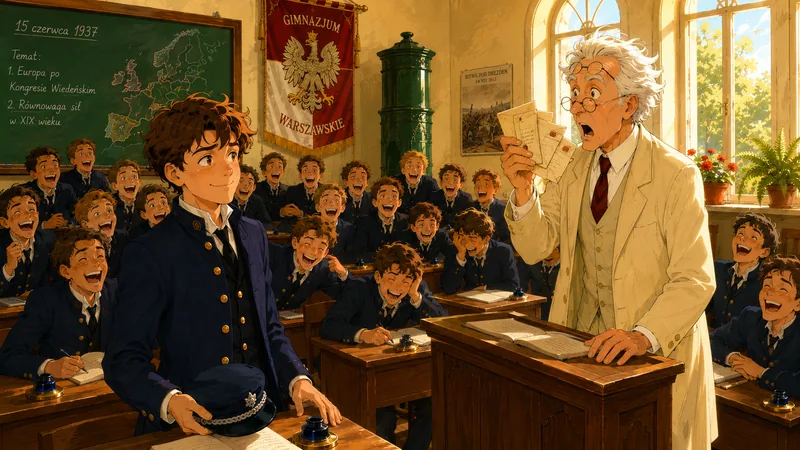
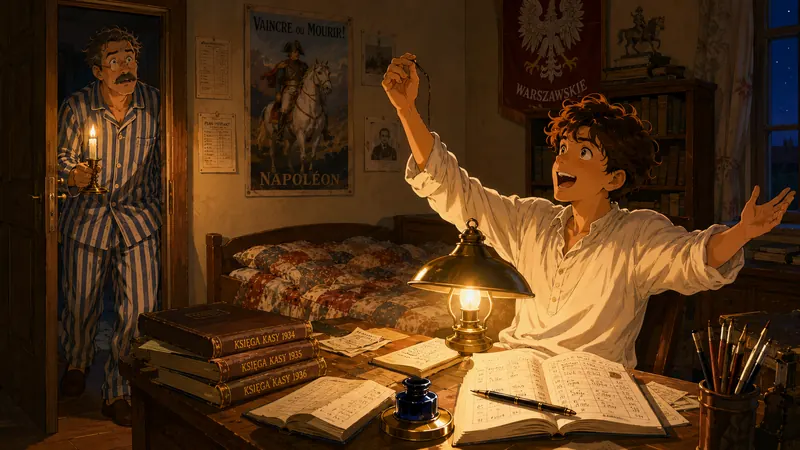
Professor Gąsowski, the silver-haired historian with the wide,
astonished eyes of a child, looked at his class the way one looks
at foreigners — with polite patience and a quiet hope that
someone, anyone, would say something sensible.
In the third row sat Adam Cisowski, short and stocky, awkward in
the shoulders but with a gaze bold and oddly piercing. Around him
thirty seventh-graders feigned an interest in the Russian campaign
of 1812.
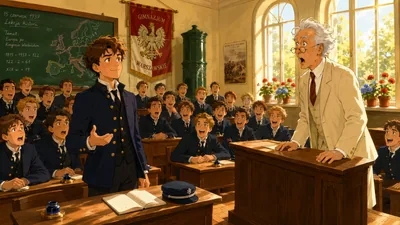
“Kaczanowski!” the Professor called.
Kaczanowski rose, opened his mouth, closed it, opened it again,
and finally wriggled out with consummate diplomacy:
“Sir, today is Thursday, and Thursday isn’t my day.”
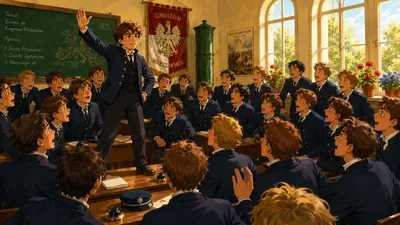
The Professor narrowed his eyes. Adam raised his hand. Thirty
heads turned slowly — they all knew that when Cisowski stood up,
something happened. Something that could not be taken back.
“Today is our Waterloo, sir. Napoleon failed to see the deep
ditch on the battlefield, and I failed to foresee the Professor’s
mistake. From that — our shameful defeat.”
The Professor stepped back and looked at Cisowski as one looks at
a sorcerer. And Cisowski spoke on, calmly, with an ironic smile
at the corner of his mouth:
“The Professor has a method. I discovered it long ago. I drafted
the form’s rota. Today it was Kaczanowski’s turn. And Ostrowicki’s.
And Wnuk’s. They all rose, and none of them knew, because today
is Thursday — and on Thursday the boy who studies is the one
going to the cinema on Friday.”
The class fell silent. You could hear the corridor clock ticking
and the quiet creak of a bench — Staszek Burski held his breath
so sharply that he nearly folded over.
Thirty pairs of eyes fixed on the Professor. The Professor fixed
his eyes on Cisowski. A long moment passed — long enough for
a history lesson to become something else entirely.
“You devil!” the Professor whispered. “You little Satan!”
That is how it began. Everything else — diamonds, letters, violet eyes — comes later.