Study guide · Janusz Korczak · 1923 · Book 2
King Matt on the Desert Island — summary
The second and final volume of Korczak's story about Maciuś, the boy king. Beaten in war, he escapes, faces the kings of the world, chooses exile on an island, and comes home again under another name. A spoiler-free overview first, then all seven parts and the ending.
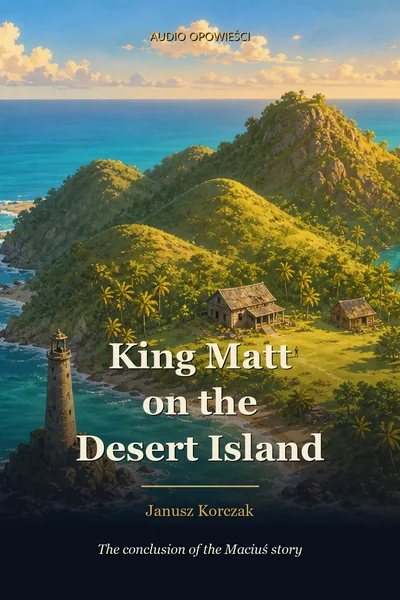
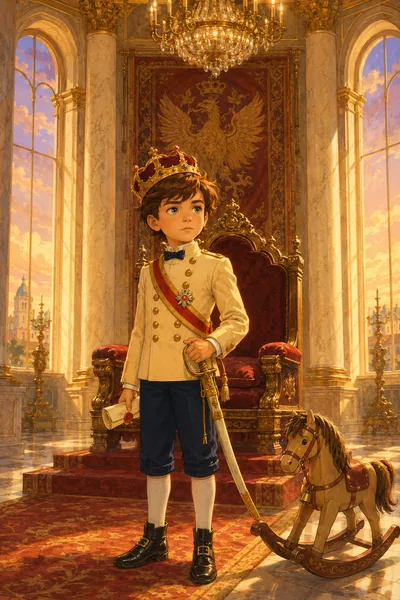
This is volume 2
Read first: King Matt the First
This book picks up the day after the first one ends: Maciuś has lost his war and is a prisoner. If you are new to the story, start with Book 1.
Spoiler-free overview
King Matt on the Desert Island (Król Maciuś na wyspie bezludnej, 1923) is Janusz Korczak's sequel to King Matt the First. In the English audiobook the hero keeps his Polish name, Maciuś (MAH-choosh). The first book ended with the child king defeated in war and sentenced to exile, "just like Napoleon", on a desert island. This book follows what happens next — and it is a very different kind of story.
The first third is an adventure: a tunnel through a prison wall, a colonel who sleeps through everything, a price on the boy's head, a hiding place in an orphanage and a council of kings that Maciuś interrupts by crawling out from under the table. Then the pace slows. On the island Maciuś reads, learns the violin, keeps a diary and tries to understand why people — children included — behave as they do. The last part brings him back into the world, to a prison, a village school and a factory.
Korczak writes simply, with jokes and sharp satire of grown-up politics, but this is also one of the most serious children's books ever written. It asks what rights children should have, whether a good person can change the world, and what it costs to try. Its ending is famous and sad; readers who want to meet it unprepared should stop at the spoiler line below.
Spoiler warning. The summary below follows the book to its last page.
Part 1 · Chapters 1–5The Prison and the Tunnel
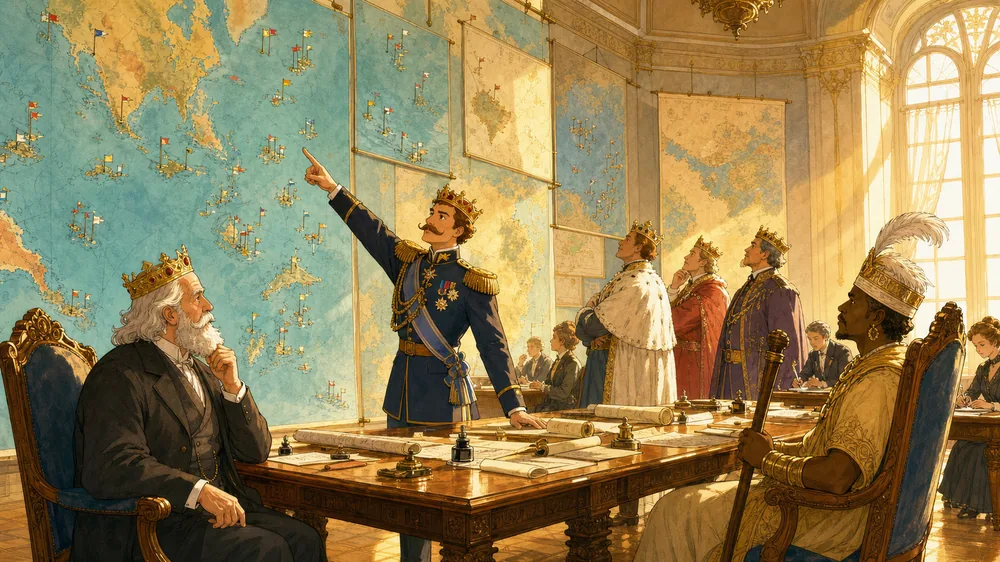
Maciuś waits in a damp cell as prisoner number two hundred and eleven while the victorious kings squabble over which island to send him to. They advertise for suggestions from geography teachers and pin little flags into world maps; over Bum-Drum's furious objections, they choose an island near the mainland with a lighthouse and an abandoned school. Queen Campanella, a kind widow, visits every day, brings him his old canary and a photograph of his mother, and finally offers to adopt him. Maciuś refuses: "I am a king in captivity, and what was taken from me, I will take back." Pretending to play Robinson Crusoe in the prison garden, he secretly loosens the bricks of the wall — but the night the tunnel is finished, he is suddenly put on a train to the coast. His escort, Colonel Dormesko, is a famous sleepyhead. Maciuś opens the carriage window, jumps out at a station and hides with a kindly railway switchman.
On the Run
Back in his capital, Maciuś carries a sack of sausages for a butcher, who takes him in as an errand boy called Janek. From the newspapers he learns how his ministers have scattered and how poor his country has become. When posters offer five million for the runaway king, he escapes a police round-up by throwing sausages to a pack of dogs and hides in an orphanage, where a secret society of children, the Green Banner, dreams of rescuing him. By a comic mix-up the director, a pompous educator, dresses him as a girl to present flowers to the prefect of police. Meanwhile the whole world is in uproar and the kings, summoned to the island of Fufajka by the unflappable diplomat Lord Pux, are forced to repeat their complaints for days on end. At last Pux asks who wishes to speak, and Maciuś crawls out from under the council table: "I ask for the floor."
Part 3 · Chapters 11–15The Sad King and the Farewell
We learn how he got there: Princess Klu-Klu smuggled him out in a crate as a stuffed dog, then rowed with him across a stormy sea. Tired and disillusioned, Maciuś tells his old friend the Sad King that he wants nothing more. At the next council the kings debate children's rights — Emperor Pafnucy wants beatings, the Sad King argues that children, like women and workers before them, deserve rights — until Klu-Klu bursts in with a band of warriors and ties up the kings. The rescue ends in horror: some of the warriors eat Queen Campanella. The kings' warships bombard the island, and Maciuś, blaming himself, asks only to go to the island: he will remain a king but not rule, his father's borders are to be restored, and the people are to choose a president. The kings throw him a drunken farewell feast, and on the island he becomes, in Korczak's words, "a philosopher — that is, a person who thinks about everything and does nothing".

The Island Diary
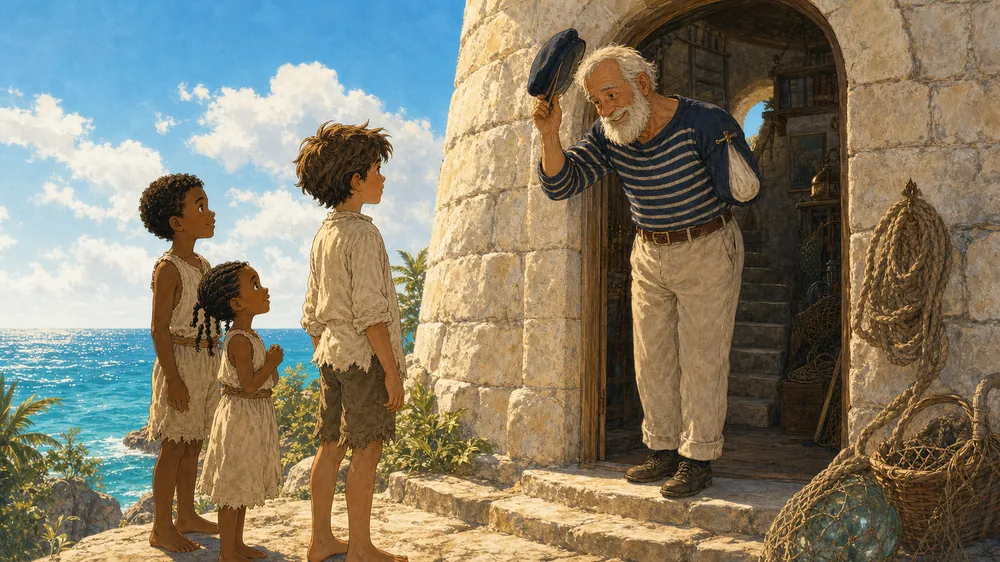
Maciuś lives in the old school with the good-natured Dormesko and a few soldiers. He imagines "little people" in his head who argue and disobey, orders books from the Sad King, learns the violin from the guard Walenty and keeps a diary: "My greatest mistake was that I was proud." Rowing to the lighthouse, he meets its one-handed keeper and two children the sea washed ashore, whom the keeper named Alo and Ala; little Ala calls Maciuś "Papa". When she wants to go to war, the old man soothes her: "The war is asleep." In the island's forest Maciuś meets a silent hermit in a strange stone tower — an adventure he can never explain. He teaches Alo to read and decides that "little children are like wild people".
A Sign from Klu-Klu
Maciuś petitions the kings to send the homesick guards home and to replace them with older boys. His canary dies; he buries it on a hill above the sea beside little graves for his parents and Campanella. Dormesko is replaced by the Marquis Amary, a hot-tempered captain who drowns Maciuś in paperwork, and the new boys smoke, jeer and make his life a misery. A tiny postal rat brings a letter inside a nut from Klu-Klu: her father Bum-Drum has been killed in a war with the white kings. When the orderly Filip kicks apart his little cemetery, Maciuś fights him — and learns that Filip grew up in a brutal reformatory. Then he walks away into the forest and lives among the island's shy wild people on an island in a lake.
Part 6 · Chapters 26–31The Holy War
In Africa, rumours turn Maciuś into a near-god, and a "holy war" against the white kings ends in slaughter. Klu-Klu leads the children out as well, and many die on the way. She sends for Maciuś; he paddles down a great river to a white town with a telegraph and wakes the world. Ships, doctors and the Red Cross arrive, and white children send breakfasts and toys in answer to his appeal. On his way to Europe, Maciuś is kidnapped by agents of the young king and locked, under a false name, in the harshest prison of all, where convicts carry coal in and out of a tunnel for nothing. The prisoners protect him, and a jailer who has lost his own son fakes his floggings, then reports him dead and helps him slip away. The world mourns King Maciuś.
Part 7 · Chapters 32–37The Last Monday
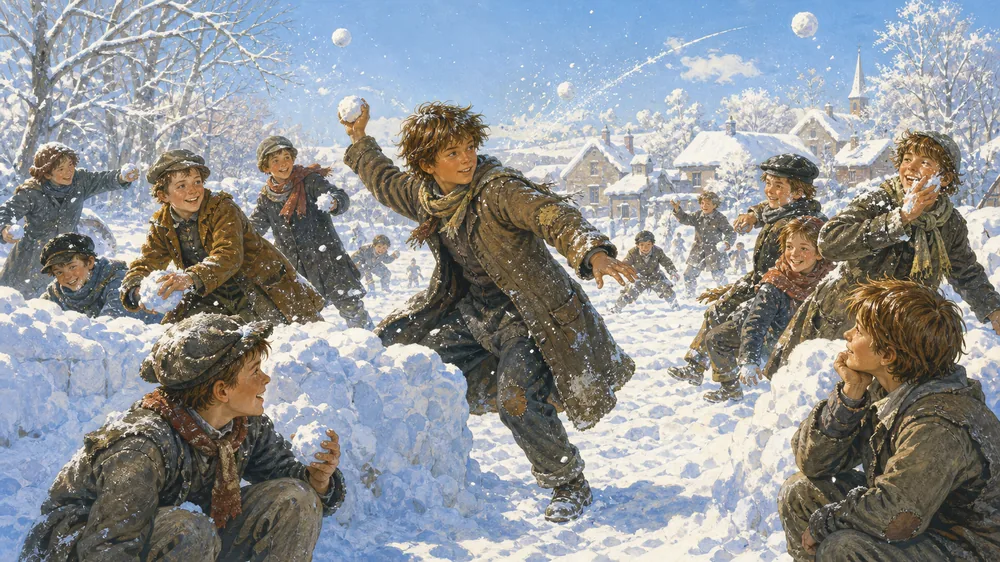
Maciuś walks home, kisses his country's soil and hires himself out as a cowherd called Marcinek. At the village school the boys mock the "stray" with holey shoes; he wins them over by fairness and a well-organised snowball war. When war threatens again, he stands up in class: "It isn't true that King Maciuś died." Back in the palace he writes to the kings that he does not want war. The young king's own generals turn against him, and he surrenders; the nation declares a republic. Maciuś refuses a pension, rents an attic room and goes to work in a small factory. Then his old friend Felek turns up, ragged and ashamed. Maciuś takes him in, but Felek grows restless and quarrelsome, and one Monday, in a fit of rage at the foreman, he shoves Maciuś, and Maciuś is caught by the machine. In hospital Maciuś asks for his keepsakes and gives his last gifts: "Take this ring, Felek. Let Klu-Klu take the earrings." He dies, and is buried on a high hill of the desert island, where Alo and Ala bring flowers — "and over the grave the canaries sing."
Themes to discuss
The kings' debate in Chapter 12 sets out every argument for and against — and the Sad King's answer.
On the island Maciuś learns that commanding his own thoughts is harder than ruling a nation.
His diary moves from pride to doubt to hard-won calm: "There are all sorts of people in the world."
Sleeping colonels, endless councils and drunken treaties show grown-ups as no wiser than children.
A switchman, convicts, a jailer and a lighthouse keeper help him when kings do not.
Written in 1923, the book reflects colonial-era attitudes; its African chapters are worth discussing with young readers.
English audiobook with illustrations
Listen to the whole story
The full English audiobook is illustrated throughout and comes as a complete edition or a 7-part serial. Voice: licensed AI narration (ElevenLabs), no cloning of real narrators — labelled in line with the EU AI Act. Play the sample and judge for yourself.